I spent much of this week in conversation, arriving fresh-faced on the heels of this year's Bled Strategic Forum, which I attended with our director and student intern. The experience had left me, perhaps for the first time, acutely conscious of my age, which is fast approaching 30. I'm 29, though I've been telling people I'm "practically 30" since I was at least 26.
What brought this on was watching our intern nervously prepare for the task I had given her: conducting an interview at this year's BSF. Having accepted that I am now firmly at the midpoint of my life - an adult, safely sequestered from the follies of youth - I became a little more aware of the strange generational territory I now occupy. I may feel worlds apart from Gen Xers and Boomers, but to a member of Gen Alpha passing me on the street, I would no doubt belong to much the same ancient caste.
This year's Bled Strategic Forum, by now a fixture of Slovenia's international calendar, ran under the headline "The Power to Shape the Future". Three days earlier, in Kranjska Gora, its younger sibling, Young BSF, had convened under a rather different banner: "After the Rupture". Taken together, the two titles neatly captured something I kept encountering in conversations with people both older and younger than myself. A generational divide not so much over what has happened to the world in the past few years, but over what anyone expects can still be done about it.
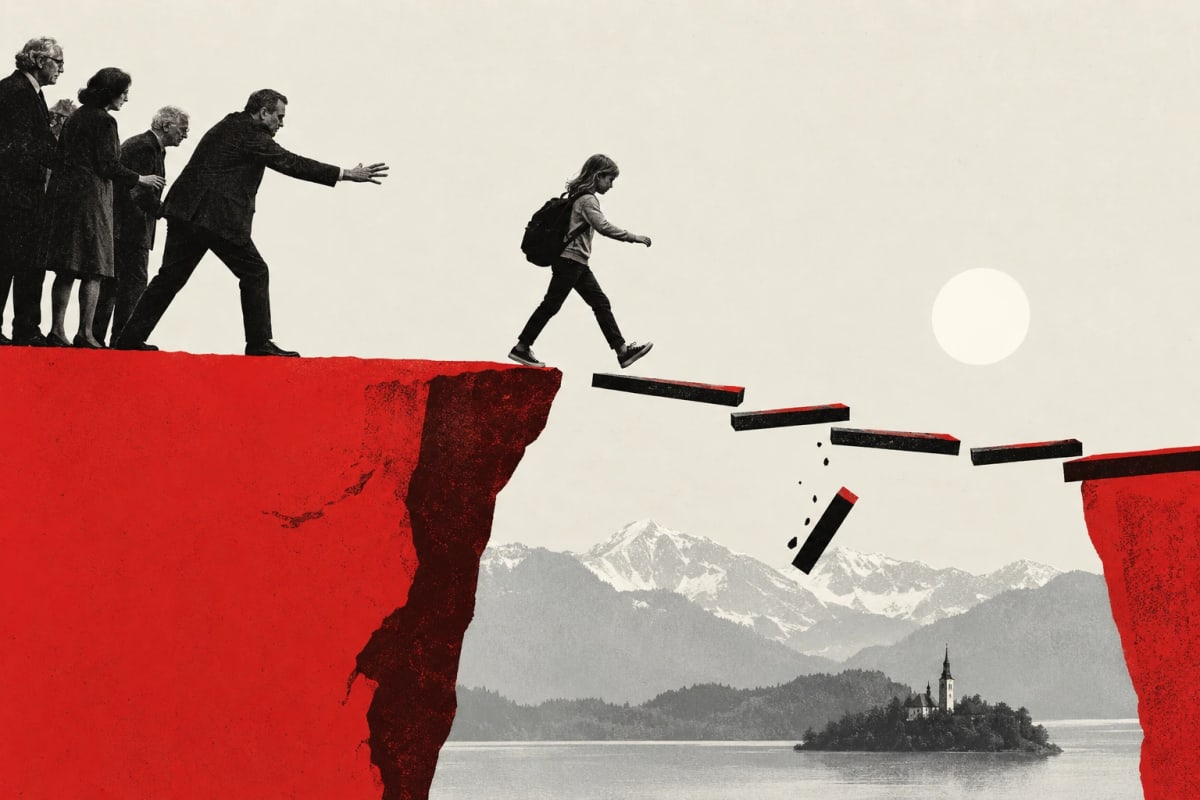
Those older than I tended to speak in the language of loss. They lamented the erosion of the multilateral order, the weakening of institutions and the increasingly casual disregard for rules and conventions that, for all their imperfections, once seemed to provide some structure to international affairs. Those younger than I were not quite apathetic. Their outlook struck me instead as a hope that, whatever becomes of the wider world, they might still carve out a tolerable corner of it for themselves somewhere in the Alps or, as one younger interlocutor joked, failing that, on Epstein's island, safely sequestered from the flames licking at everything beyond their chosen refuge.
It is not difficult to understand, let alone fault, the former view, particularly among much of this readership, older and considerably wiser than I. Your youth was shaped by a vision of the world that was, if not simpler, then certainly more hopeful and more legible than the one inherited by my generation and those after it. You saw Slovenia declare independence in 1991, join NATO in 2004 and adopt the euro in 2007. You watched a set of rules, alliances and institutions turn a small, newly independent state into one with security, prosperity and standing far beyond what its size might otherwise have afforded it.
We were not raised badly. If anything, we were raised too well. We inherited institutions whose construction we had not witnessed and securities whose absence we had never really had to contemplate. Only now are we discovering that none of them came with a lifetime guarantee.
The instinct, particularly among those who remember what came before, is understandably to protect the generations that follow from whatever comes next. But one thing I was reminded of this week is that protection can become its own kind of handicap. The easiest way to learn how to swim is, at some point, to be put in the water. Our intern was nervous about conducting her interview at Bled. I gave her the assignment anyway, then rather unhelpfully disappeared into the crowd to mingle and network. She did splendidly. More importantly, by the end of it she no longer needed me hovering over her shoulder.
There may be a political lesson in that as well. We spend a great deal of time asking how to restore young people's faith in institutions, how to make them participate and how to persuade them that the future is still theirs to shape. Perhaps part of the answer is to stop treating them as spectators of a world built by somebody else. Give them responsibility before they feel entirely ready for it.
A generation spared every mistake will eventually inherit problems it has never been allowed to practise solving.
Andraž Tavčar, Executive Editor of The Adriatic
I am aware, of course, of the irony in a childless 29-year-old dispensing parenting advice to a readership containing people who have actually raised children. Consider this less a manual for child-rearing than an observation from someone who has only recently discovered that he is now old enough to be entrusted with interns.
In other words: let your children screw up. Not because failure is virtuous, nor because the stakes have become any smaller, but because the ability to shape the future cannot be taught entirely in theory. A generation spared every mistake will eventually inherit problems it has never been allowed to practise solving.