
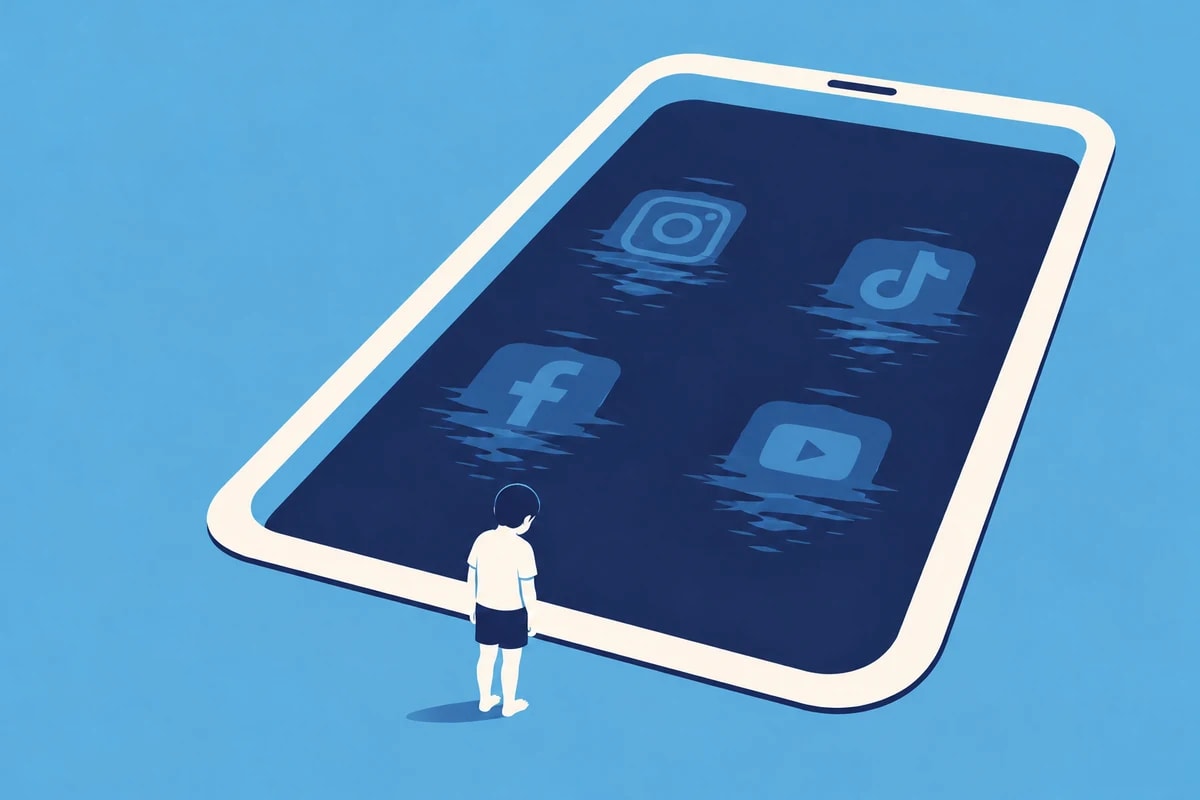
We are increasingly shielding children from the dangers of the outside world, while at the same time putting devices into their hands that give them almost unlimited access to the digital world. In playgrounds, on the streets and when they spend time with their peers, we try to protect them from risks. Yet online, we often leave them exposed to an environment over which we have far less control.
Since 2010, much of teenagers' social lives across Western countries has shifted onto smartphones. Young people have gained constant access to social media, video games and other online activities. Over the same period, many countries have witnessed a marked deterioration in young people's mental health, reflected in rising levels of anxiety, depression and self-harm. In his book The Anxious Generation, social psychologist Jonathan Haidt identifies the widespread adoption of smartphones as one of the key drivers of these changes.
Generation Z, born between 1997 and 2012, is the first generation to have spent much of its childhood in a world dominated by smartphones. Generation Alpha, born into an already digital world, is now following the same path. Haidt warns of what he calls the "Great Rewiring": a shift away from a childhood centred on play, social interaction and real-world experiences towards one increasingly dominated by screens.
Young people today spend less time with their peers, less time outdoors and have fewer opportunities to develop social and physical skills. Smartphones are encroaching on the space once occupied by free play, exploring the world around them, forming friendships and learning to resolve conflicts with other children. Yet these are precisely the experiences that are essential to healthy development.
The years between the ages of 9 and 15 are particularly important for social learning and identity formation. Children need obstacles, setbacks, disappointments and the occasional fall. These experiences help them build confidence, independence and the ability to cope with life's challenges. Retreating into the world of smartphones deprives them of these opportunities.
Haidt identifies four fundamental harms arising from the Great Rewiring: social deprivation, sleep deprivation, fragmented attention and addiction. Alongside this apparent erosion of young people's mental health runs a second trend: overprotective parenting.
Parents increasingly monitor and restrict their children's movements and activities in the real world, while allowing them virtually unrestricted access to smartphones from an early age. Children are therefore losing freedom where they need it most for their development, while gaining it in an environment where they face risks they are not yet equipped to assess. Instead of developing resilience and independence through real-life experiences, they spend ever more time in front of screens.
How should we respond as a society? Last year, Slovenia tightened the rules governing the use of electronic devices in primary schools. Other countries are introducing restrictions too. In the Netherlands, mobile phones are generally prohibited during lessons, subject to certain exceptions, while Croatia has introduced similar restrictions in primary schools. Further measures are being discussed in Spain, Sweden and elsewhere.
Some schools are also bringing back more opportunities for free, unstructured play, allowing children to explore relationships, resolve conflicts and develop social skills. Across the European Union, calls are growing for a higher minimum age for access to social media.
Parents have an equally important role to play. One encouraging example is the Slovenian initiative Počakajmo skupaj (Let's Wait Together), launched by parents at a Slovenian primary school and supported by several thousand signatories. It is based on a voluntary agreement among parents to delay buying their children a smartphone until the end of primary school, and to postpone access to social media until at least the age of 16.
This helps reduce peer pressure. When children know that others in their class do not yet have smartphones either, waiting becomes easier. Parents, meanwhile, no longer feel they are making these decisions alone.
The choices we make today will help shape the mental health of tomorrow's adults — the entrepreneurs, farmers, cultural workers and public servants on whom our society will depend. The more widespread mental health difficulties become, the greater the demand for professional support, with consequences potentially extending into many other areas of life.
That is why, through initiatives such as these and through our own choices, we must help young people grow into healthy, confident and independent adults.
Technology is a force for good and has brought advances to our society that would once have been unimaginable. But not all its consequences are beneficial. Liberal thinking is one of the guiding principles of the Institute for Strategic Solutions, which publishes The Adriatic, so advocating restrictions may seem contradictory. Here, the great liberal philosopher John Stuart Mill offers a useful perspective. He accepted that individual liberty could be restricted to prevent harm to others and recognised the need for greater protection of children.
This raises a question worth asking: by granting children unlimited digital freedom, are we not, in fact, diminishing their chances of growing into truly free and independent adults?