
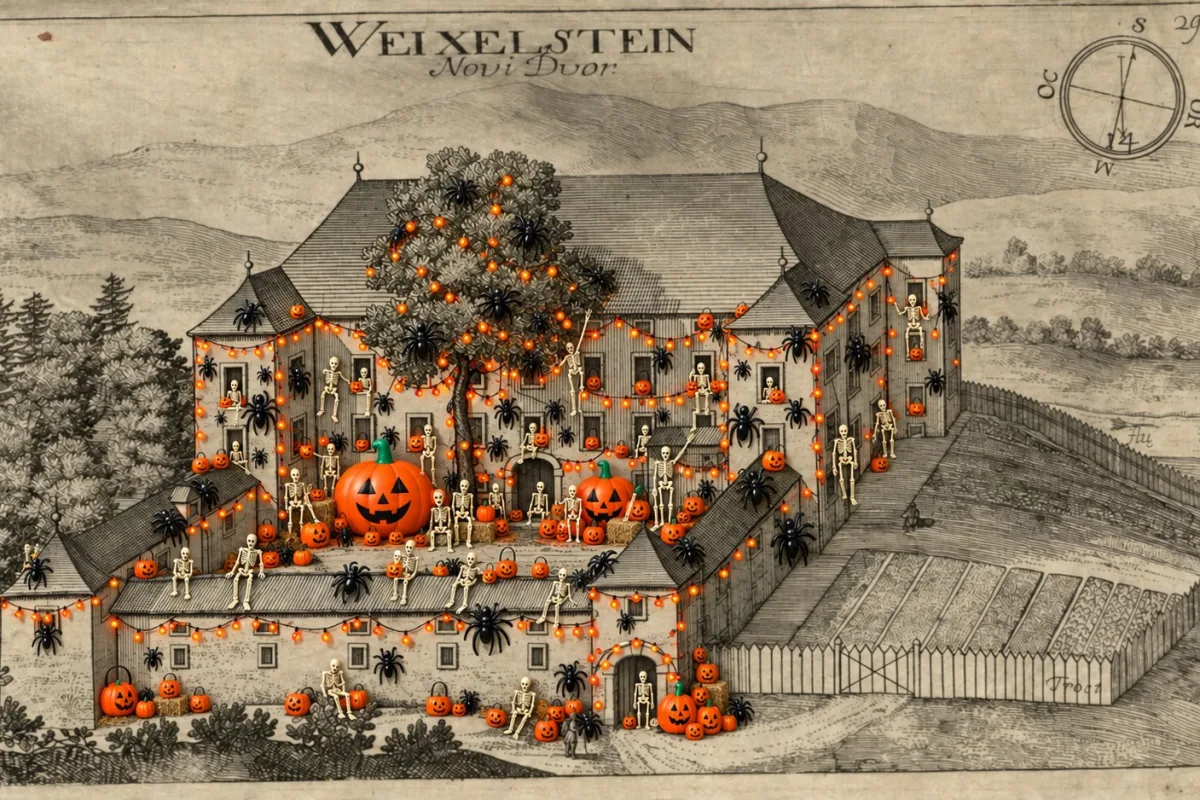
A curious transition befalls Slovenia in late October. Seemingly out of nowhere, supermarket aisles fill with sugar pumpkins, plastic skeletons, and rubber spiders. Children dress up as witches, adults explore the stylistic possibilities of fake blood, and the hospitality industry celebrates yet another occasion for seasonal parties.
Undeniably, Halloween has become a fixture of Slovenian life. Brought over by American television shows of the 1990s, it has gained enthusiastic devotees and equally eager detractors. Ethnologists complain about creeping Americanisation. Children, quite understandably, prefer sweets to cultural studies. The fun is mostly harmless, and occasionally cheap. The problem is not Halloween itself, but the way it overwrites what came before.
Consider the British, who have been suffering from a supernatural crisis of their own. Their undead apparitions, apparently, are disappearing.
For centuries, every respectable castle was expected to have at least one ghost, just as it had draughty staircases and exorbitant maintenance bills. The preferred spectres were those of unhappy noblewomen, battered by their husbands or by their relatives, condemned to wander the corridors until the ancient injustices were finally resolved. Ghosts were a core part of cultural heritage.
Then came modernity. In 2001 Tony Cornell, a researcher associated with the Society for Psychical Research, blamed mobile phones for the decline in paranormal manifestations. The undead, he suggested, found electromagnetic signals disturbing. The theory was never accepted by scientists, but it seemed to resolve an old challenge: it is surprisingly difficult to meet a ghost.
More recently, Paul Lee, a British paranormal researcher, surveyed thousands of supposedly haunted properties. In many of them, he discovered, there was no longer any discernible supernatural activity. The traditional inhabitants of haunted houses had become less reliable than the plumbing.
"For centuries, every respectable castle was expected to have at least one ghost, just as it had draughty staircases and exorbitant maintenance bills."
Slovenia, meanwhile, has no shortage of ghosts. They haunt old castles, dark forests, and country roads. At Rajhenburg Castle, the spirits of two brothers are said to continue their murderous quarrel. At Pišece, a little girl is still imprisoned inside a tower and cannot find the exit. At Negova Castle, the cellar is still haunted by the screams of a woman tortured to death.
In the 19th century, some Slovenian ghosts even achieved international fame. Long before Hollywood exploited the commercial possibilities of the supernatural, the country’s apparitions were mentioned in the spiritualist press of Europe and America.
In September 1879 the London newspaper The Spiritualist published a remarkable account of a haunting at Weixelstein Castle (Novi dvor, near Radeče), supplied by Captain Richard Francis Burton. The celebrated explorer, then British consul at Trieste, had come across the dusty tomes of Die Ehre dess Hertzogthums Crain, Janez Vajkard Valvasor’s great survey of Carniola, published in 1689, and was happy to recount the story of a spirit preoccupied with an unpaid spiritual debt. It claimed to have misappropriated 60 florins and demanded 30 masses for the salvation of its soul. A servant named Anka had become its principal medium. When the required masses had been performed, the ghost announced that it was finally going to heaven. An unexpectedly satisfactory conclusion, reached through faithful Catholicism rather than the dark arts.
In 1897 the Leipzig journal Psychische Studien reported on a ghostly visitation at the Franciscan monastery of Nazarje. The apparition, identified as a deceased friar from Ljubljana, had reportedly appeared to Father Dominik in the 18th century to ask for prayers and assistance. The story had already been told in 1892 in Cvetje z vertov sv. Frančiška, a Slovenian Catholic publication.
Not every ghost was so concerned about its salvation. In 1893 the German-language occult journal Sphinx reported on a noisy flat in Ljubljana. Imagine the horror! For 18 months, beds creaked without apparent cause. The author, Franz Potočnik, initially poked fun at the witnesses, before becoming a believer himself.
These stories have something the cheap Halloween decorations lack: a past. They are tied to actual buildings, reflect particular anxieties, and preserve the preoccupations of the people who regaled listeners with them. These ghosts seek justice, forgiveness, or redemption, or simply make a bed unusually noisy.
"Folklore does not have to remain frozen in the past to survive."
And they are not necessarily extinct. The folklorist Ambrož Kvartič has documented the legend of a mysterious woman who appears to motorists travelling through Huda luknja, the gorge between Velenje and Slovenj Gradec, only to vanish from their cars. This apparition is a devotee of modern transport. Folklore does not have to remain frozen in the past to survive.
A belief in ghosts is hardly a prerequisite for enjoying a good ghost story. What Halloween is displacing is the storytelling itself. The plastic skeleton has no biography. The artificial witch has no local address.