
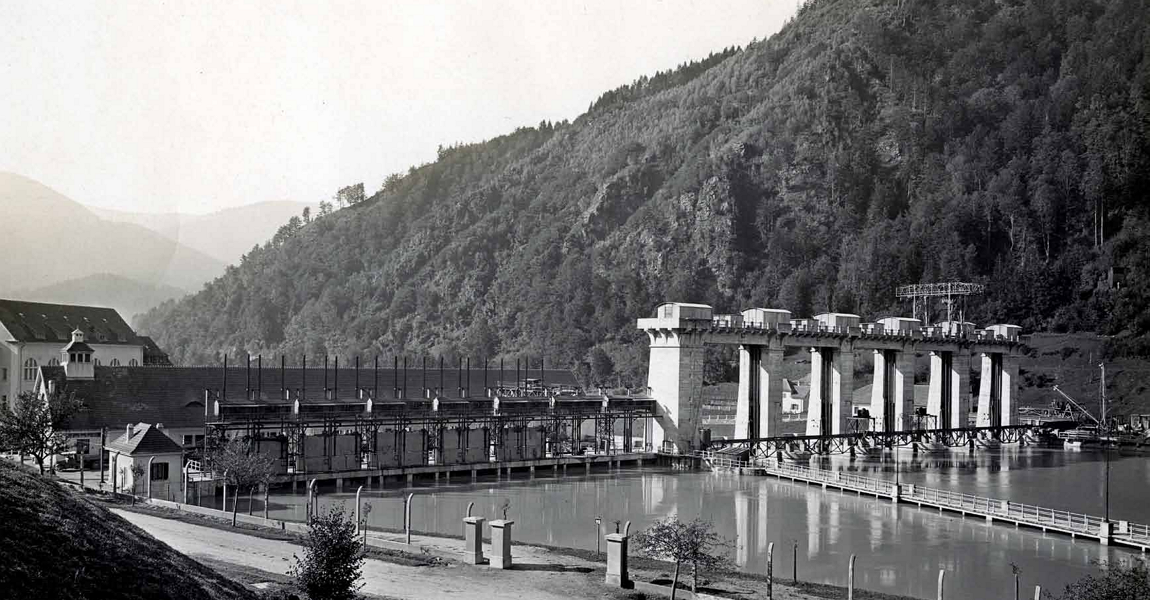
The first light came on in Selnica ob Dravi on 23 May 1918. The village still marks that day as its municipal holiday. A few kilometres downstream, the Fala hydropower plant had just started its fifth generating unit. It was the first plant to dam the Slovenian stretch of the Drava, and it began the chain that Dravske elektrarne Maribor (DEM) runs today.
Built for Graz, inherited by Maribor
Fala was not designed for Slovenia. A concession was granted in September 1912 to the Graz engineering firm Albert Buss & Cie., Karl Scherbaum, and a machine works near Vienna. It passed to Steiermärkische Elektrizitäts-Gesellschaft (StEG) in 1913. The plan was to supply the industrial basin of central Styria around Graz. Swiss firms, then the most experienced hydropower builders in Europe, designed the plant, managed the works, and supplied most of the equipment, and Swiss banks lent the money.
The project survived the First World War because the army needed it. Work stopped in early 1915 but resumed that autumn, because the nitrogen factory in nearby Ruše needed power for war production. Russian and Italian prisoners of war were sent to the site. On 6 May 1918, the first three units began operating. By the end of the month, five were running, with a combined 20 MW.
Within months, the empire had collapsed, and the new border placed Fala in the Kingdom of Serbs, Croats and Slovenes. Plans built around Graz were redirected south and east. Maribor had signed a supply contract with StEG as early as July 1914, and power reached the city in late autumn 1920. The writer Jaro Dolar later recalled the evening of 8 December 1920, when "the first electric bulb lit up" in his family's flat. Transmission lines followed towards Prekmurje and Hrvatsko Zagorje. In 1936, Fala produced a fifth of all Yugoslavia's electricity, underpinning the industrial growth of interwar Maribor.
The end of the rafters
The dam also changed an older Drava economy. For centuries, timber from the Pohorje and Kozjak forests had travelled on rafts down the Drava to the Danube. The concession obliged StEG to build a 7-by-34-metre raft lock and a fish ladder. Before the other dams were built, up to 20 rafts a day passed Fala between spring and autumn, each carrying 90 to 100 cubic metres of wood. In 1937, the writer Anton Ingolič joined the rafters for three weeks with forged papers and later described their life in his novel Na splavih (On the Rafts).
The last raft bound for the Danube left on 6 April 1941, the day the Axis invaded Yugoslavia. The last rafts crossed the Fala dam in 1947. After that, the new Mariborski otok plant closed the route.
War, nationalisation and a chain of eight
During the Second World War, the occupying authorities seized Fala and placed it in EV Süd, a company based in Maribor. The plant kept running, but it became a target. On the night of 27 to 28 September 1944, a partisan raid put it out of action, and it restarted on 2 October. After the war, it was nationalised and connected to Slovenia's new 110 kV grid.
The chain grew quickly. Dravograd was completed in 1944 and Mariborski otok in 1948. Vuzenica followed in 1953, Vuhred in 1956, and Ožbalt in 1960, as postwar Yugoslavia electrified its industry. By then, six plants lined the narrow valley between Dravograd and Maribor.
The company itself took several attempts to form. Dravske elektrarne was founded on 1 October 1951, combining Fala, Mariborski otok, and the Vuzenica construction site. It was broken up a year later. The plants were reunited as Dravske elektrarne Maribor on 1 July 1961, with headquarters in the building that had housed the Fala company before the war.
Below Maribor
Below Maribor, the valley opens onto the Drava plain, which needed a different design. Construction of the next plant, first called Srednja Drava 1 and now known as Zlatoličje, began on 1 October 1964. It was the first Yugoslav canal-type plant: a weir at Melje in Maribor diverts the river into a concrete-lined, 17-kilometre canal, which leads to the powerhouse at Zlatoličje.
Around 1,200 workers moved 13.2 million cubic metres of earth and poured 285,000 cubic metres of concrete. Raising the water behind the Melje weir meant rebuilding Maribor's riverbanks, laying a new sewer collector, and building 190 new flats. It also threatened the Water Tower on Lent, a defensive tower from 1552. Engineers cut the 1,500-tonne structure from its foundations and jacked it up by 2.6 metres. The work lasted from December 1967 to July 1968.
The river entered the canal on 13 October 1968. Josip Broz Tito, the Yugoslav president, opened the plant on 26 April 1969. At the time, it raised Slovenia's electricity output by 28 per cent. The last link, Formin, near Ptuj, started operating in 1978.
New machines in old walls
Modernisation has been continuous. Fala has had a new machine hall, new units, and digital control. After successive renovations, it now operates with three units. Its installed capacity has grown from 20 MW to 58 MW. In 2014, it reached a record 353.5 GWh. By its centenary in 2018, it had produced about 19,400 GWh. Since 2008, it has been a cultural monument of national importance, and retired employees guide visitors through the museum in the old machine hall.
Zlatoličje and the Melje weir were renovated between 2006 and 2013 for about 62 million euros, and a new small plant was built at Melje. Zlatoličje's capacity rose by 12 MW to 126 MW, and the renovation raised its average annual output by 34 GWh. This spring, DEM completed a three-year renewal of the control and protection systems at Dravograd, Vuzenica, and Mariborski otok. The project included a digital turbine governor developed by DEM's own engineers.
Formin is the only large plant on the Slovenian Drava that has not yet had a thorough overhaul. Work is due to start in 2027 and finish in 2029. It will raise capacity from 116 MW to almost 131 MW and annual output from about 548 GWh to nearly 589 GWh, enough for about 12,000 more households.
Water, sun and storage
DEM now runs eight large and six small hydropower plants, as well as solar plants. Together they produce about 2,800 GWh a year, around a quarter of Slovenia's electricity, and the hydropower plants alone account for close to 600 MW of capacity. By the company's 70th anniversary in 2021, the Drava plants had delivered almost 150,000 GWh to the grid.
"Our mission remains the same as at the beginning of hydropower on the Slovenian Drava: to provide electricity for life and economic development," DEM says. Solar plants along the Zlatoličje and Formin canals combine water and sun on land already used for energy. Battery storage can respond quickly to a changing grid. The proposed Kozjak pumped-storage plant would do the same on a much larger scale: it would pump water to an upper reservoir when electricity is plentiful and release it through turbines when demand rises.
The company's predecessors made electrification and industrial development possible. DEM is building on that legacy for a power system that draws more and more of its energy from renewable sources.