
Marko Grad left high school at 16 to build a career in business. He became the youngest winner of MIT's international business competition and the youngest brand manager in Jägermeister's history, then left the corporate world to run the Global Shapers Institute, a non-profit that speaks for young people in Slovenia. The institute runs free educational events, AI workshops and public debates in high schools and universities across the country. In September President Nataša Pirc Musar awarded him and the institute the presidential memorial coin for their work with young people.
What does your ideal weekend look like?
Quiet. I'm busy all the time, so I spend weekends in nature or in the city with noise-cancelling headphones on and nowhere in particular to be. I walk, think back on the past week and plan the next one. Those two days are when I rest and catch up on everything I run out of time for. However hectic the week gets, with long hours at the office, knowing the weekend is mine keeps me grounded.
What is always on the table at the weekend?
Speciality coffee, usually a couple of bags from Banibeans or another roaster I want to try. Over the years, making filter coffee has become a ritual of mine. Exploring beans from different origins and tweaking all the variables forces me to slow down and stay completely present.
Through the Global Shapers Institute, you build programmes that help young people turn their ideas into action and discover what school does not teach. What did you have to learn outside formal education yourself?
How to work with other people. School is built so that everyone competes against everyone else, and I never felt I belonged in that system. I left disillusioned, because I realised that everything noteworthy in human history was built together, by people trading ideas, experience and skills. That belief only grew as my career took me through start-ups and corporate jobs and, eventually, to the institute. Knowing that I have built a network of different opinions, mindsets, skills and backgrounds is what makes me believe in the change we can still make.
Six years ago my mentor at MIT, Erdin, put it simply, and I still remember his words: "If you want to go fast, go alone. If you want to go far, go together."
From where you stand, what is Slovenia getting right in how it supports young people, and where does it still fall short?
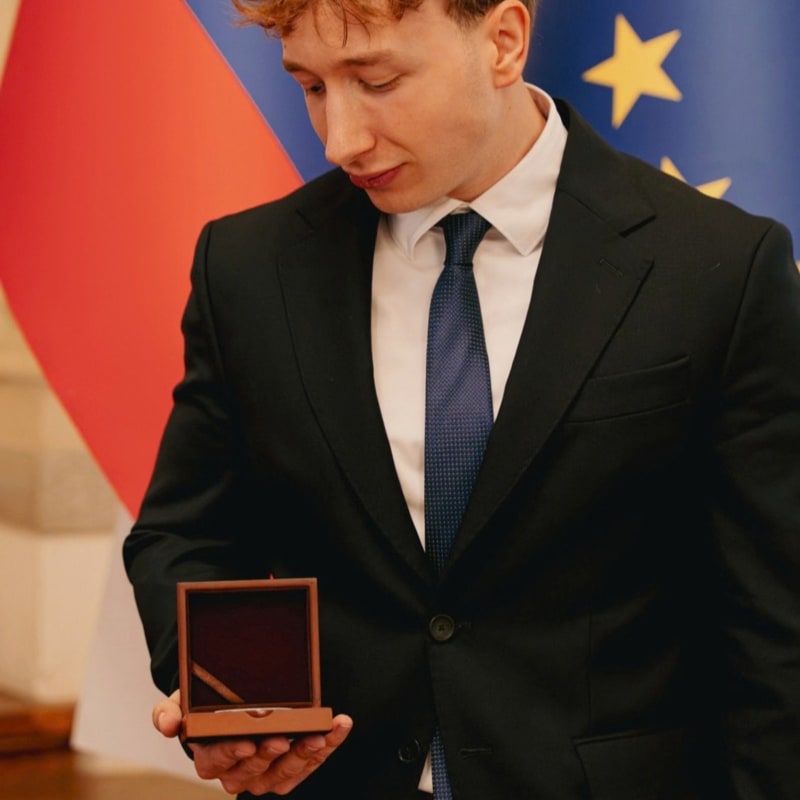
We are taking good steps in giving young people a voice. For us, the clearest sign came this year, when President Nataša Pirc Musar awarded me and the institute the presidential memorial coin for amplifying young people's voices and fostering active citizenship. Recognition like that matters a lot to an organisation like ours. It shows us that, although the work is only getting started, we are heading in the right direction.
Where we fall short is representation. Young people are barely represented in schools, business or government. Not every opinion they have needs to become policy, but they need a place where their voices are heard. Taking that responsibility into our own hands was a turning point.
A few weeks after I quit my job at Jägermeister, my co-founder and I sat on a bench and talked through what was stopping us from making the change we wanted. We realised volunteering wasn't enough. To amplify young people's voices, we had to get serious and turn the institute into far more than it was. Winning MIT's business competition and getting into a master's programme without a high-school diploma had already shown me I was more capable than I thought. On that bench I decided that if I wanted real change, the institute and I had to become the change.
Picture someone turning 20 in Ljubljana ten years from now. What do you hope will be easier for them than it was for you?
The youngest member of our institute is 17. When I was 17, there were far fewer things I could throw myself into. Now we have a 17-year-old running our programmes for other 17-year-olds, so the bar is already higher. A decade from now, I want young people stepping into the critical roles where their voices are needed most, shaping the policies that will define their lives. Right now there is a profound disconnect between the generation raising the alarm on critical issues and the generation holding the power to fix them. Because of that gap, urgent topics are often sidelined or given less priority than the concerns of older generations.
I recently realised that a time will come when even I will not know what is best for the next generation. That is exactly why we will always work with them directly. They know what they need. They know what is missing. I want a 20-year-old who feels ambitious but out of place to find like-minded people rather than standing alone, waiting for the world to change.
If you were to ask me why I do this, my answer is short: because someone has to.