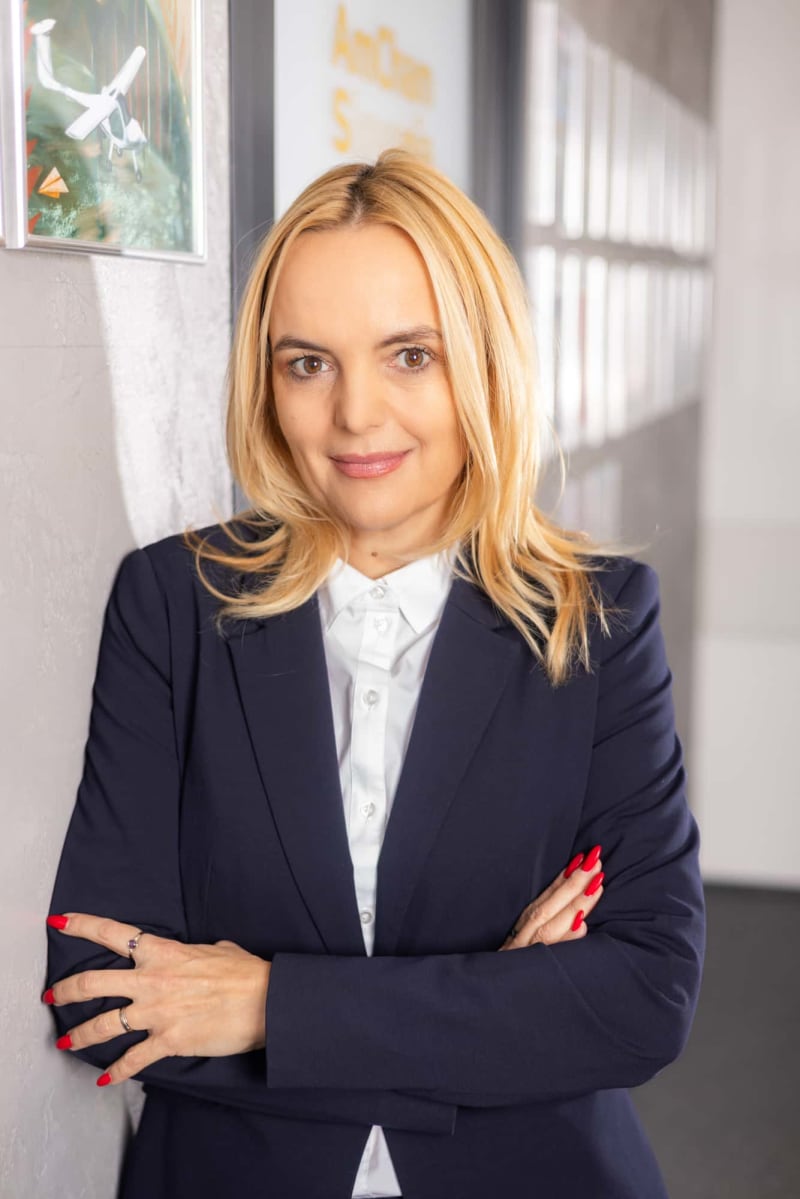
Ajša Vodnik went on air at nineteen and stayed in Slovenian television for fourteen years, the last five co-owning the channel she appeared on, before deciding the work no longer matched her compass. She now runs AmCham Slovenia and chairs AmChams in Europe, 50 chambers across 48 countries, though she would dispute that this is a second act: in her telling, there is only ever one continuous story.
Where do we find you this weekend?
At one of my favourite places in Istria, with one of my favourite people. I have four favourites: my three grown-up kids and my husband. You can only guess who spends weekends with me. It is a rare moment when I can simply be: autumn is usually wild in the office. That is why sometimes all you need is a sunset and one glass, no more, of excellent white wine.
What is always on the table at the weekend?
On the table, under the table and around the table, there is always plenty of sport: tennis, cycling, swimming, anything that keeps me moving. Movement is freedom: it gives peace to the mind and challenges the body.
You spent fourteen years building something in television, then sold your stake and started over. How do you know when it is time to leave?
I worked in television from the age of nineteen, and for the final five years I co-owned and ran a television channel with a business partner, both behind and in front of the camera. You know it is time to leave when what you do no longer aligns with your values or your inner compass. But I do not believe we ever truly start over; life is one continuous story, until our chapter ends and the energy continues somewhere else.
"Geopolitical challenges are real, but perhaps that is precisely where business has its most important role: keeping us connected when politics pulls us apart."
Ajša Vodnik, CEO of AmCham Slovenia
You went from making television to running a room full of executives. What do you miss about the old job?
Honestly, I do not miss anything, and I regret even less. I prefer to look forward and ask what I can create now: a better environment for business and for life is the answer. There are so many wonderful people to meet and beautiful stories to help write.
You bridge American and European business at a moment when the two sides are not always talking. What makes you think the bridge will hold?
Transatlantic business is so deeply connected that it is sometimes misleading to speak of "two sides" at all. Trade, investment and people have already built a very strong bridge. Geopolitical challenges are real, but perhaps that is precisely where business has its most important role: keeping us connected when politics pulls us apart.