The Institute for Strategic Solutions (ISR), in partnership with SPIRIT Slovenia, convened policymakers, economists and business leaders at EU House to examine how Slovenia's export-driven economy can withstand sudden geopolitical and economic shocks and seize new opportunities on global markets.
"Uncertainty is the constant that keeps repeating," said Tine Kračun, director of ISR. "Just when we thought the war with Iran was over, this morning brought news of fresh attacks. What happened at the Nato summit yesterday is felt in the business environment today. Politics now has an ever-stronger grip on the economy."
Global shocks and Slovenia's role
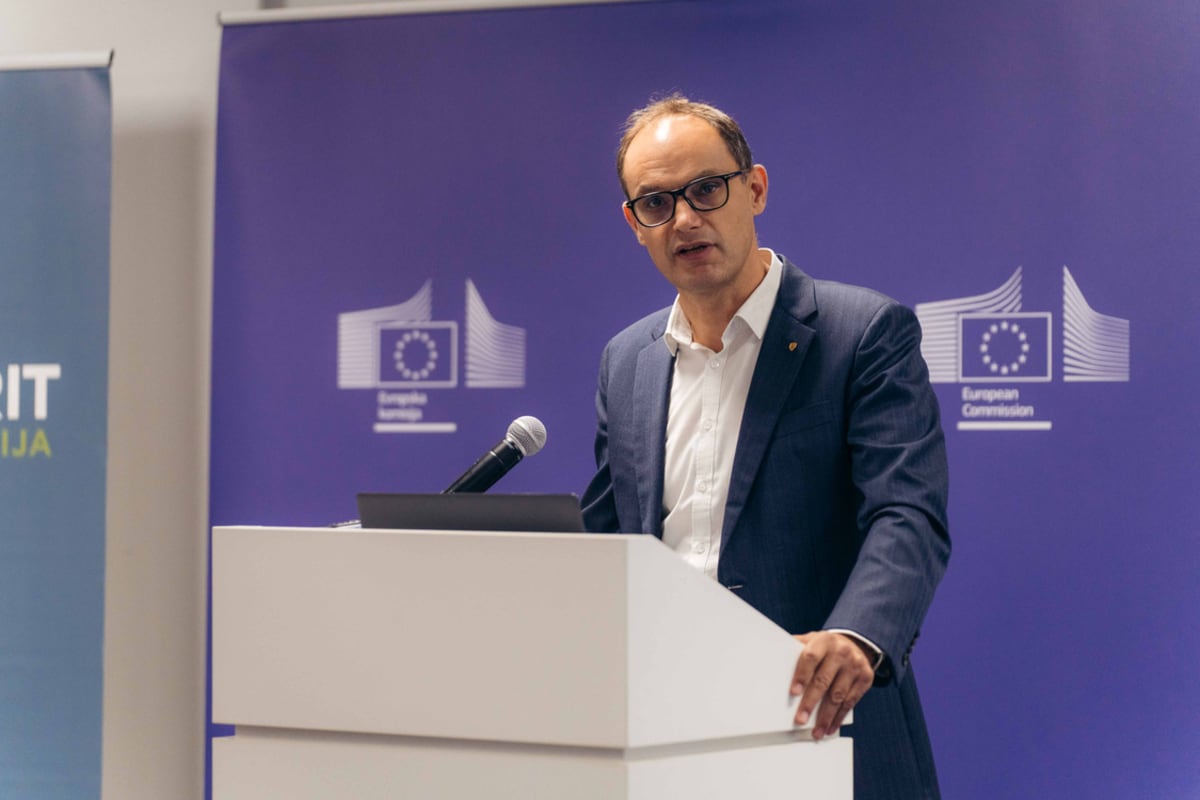
Dr Anže Logar, deputy prime minister and minister for the economy, labour and sport, noted that seven in ten Slovenian exporters are also importers, meaning global shocks hit them directly. "In two decades, the European economy has slipped from parity with the United States to roughly a third smaller, while China has been adding about a third more investment than the EU and US combined," he said. Slovenia's weaknesses, he added, are bureaucracy, tax burdens and the relocation of business activity abroad. "We have the knowledge and the people, but we must speed up processes, strengthen our development vision and seek opportunities in sectors like pharmaceuticals and data centres."
Dr Jerneja Jug Jerše, head of the European Commission Representation in Slovenia, argued that while it is right for Slovenia to look beyond European markets in uncertain times, the EU must remain its anchor. "Europe has brought Slovenia integration, the euro and a strong internal market. A new EU budget with 450 billion euros for the economy is in preparation, and I hope Slovenian firms will know how to use it effectively."
Geopolitics as business model
Prof. Dr Mojmir Mrak of the University of Ljubljana's Faculty of Economics explained that geopolitics and macroeconomics are now inseparable: geopolitics directly shapes energy, trade, investment, inflation, financial markets and supply chains. "Macroeconomics sets the rules of the game; the business environment determines how well we can play within them. Slovenia, as a small, open economy, is particularly exposed to global shifts, though the EU and the euro provide an important protective framework." He pointed to Slovenia's fall from 35th to 49th place on the IMD competitiveness ranking as evidence of an urgent need for structural reform.
Dr Jure Stojan, partner and director of research at ISR, presented the shocks that have buffeted the Slovenian economy over the past two decades. "After the initial positive effect of EU integration came the crisis, recovery, and then a new sequence of negative turns, with the Covid shock the most severe since 2000." Shocks affect industries differently: what is a blow for some can be an opportunity for others. Recent events linked to the Iran crisis have hit Slovenia's textile industry and the animal fats and oils segment particularly hard.
Underestimating risk, over-relying on the state
Sergej Simoniti, director of Coface in Slovenia, said analysts have observed pronounced uncertainty around investment, strong pressure on margins and the daily presence of geopolitics in business decisions. Despite relatively favourable macroeconomic indicators, firms remain cautious about the future. "Slovenian companies often fail to identify and quantify risks precisely enough. They rely on a sense of relative safety and expect the state to shield them. That is not consistent with a liberal economy."
Tamara Zajec Balažič, director of SPIRIT Slovenia, said the agency is increasingly focused on eastern and more distant markets, helping firms mitigate risks in those regions. "Europe remains the central point for Slovenian business, but we also help companies strengthen diversification elsewhere." SPIRIT is building stronger ties across the Western Balkans, with Serbia remaining an important partner and additional opportunities in Greece and Turkey. Long-term predictability and stability, she said, are key to attracting investors from more volatile regions.
A predictably unpredictable world
Ivana Vrviščar, a member of the management board at Post of Slovenia, described the global environment as "predictably unpredictable." Understanding that unpredictability, she said, means having multiple scenarios ready and the ability to adapt quickly. Global trade no longer works as it did fifteen years ago, and global platforms have introduced entirely new risks that firms must factor into their planning. She highlighted Maribor airport as an untapped logistics-hub opportunity. "We have an excellent location, regional integration and infrastructure, but without a clear national strategic direction positioning Slovenia as an entry point for global flows, we will keep losing investment potential."
Asked to name the single most significant risk facing Slovenia's economy, Zajec Balažič pointed to workforce shortages and the challenge of attracting labour; Vrviščar cited geopolitical tensions, for which firms are unprepared; and Simoniti highlighted lagging productivity and local political tensions. "The state, with all the burdens it imposes, creates an uninviting investment climate with enormous transaction costs. The shift would be for individuals to rely more on themselves, not on an abstract state."