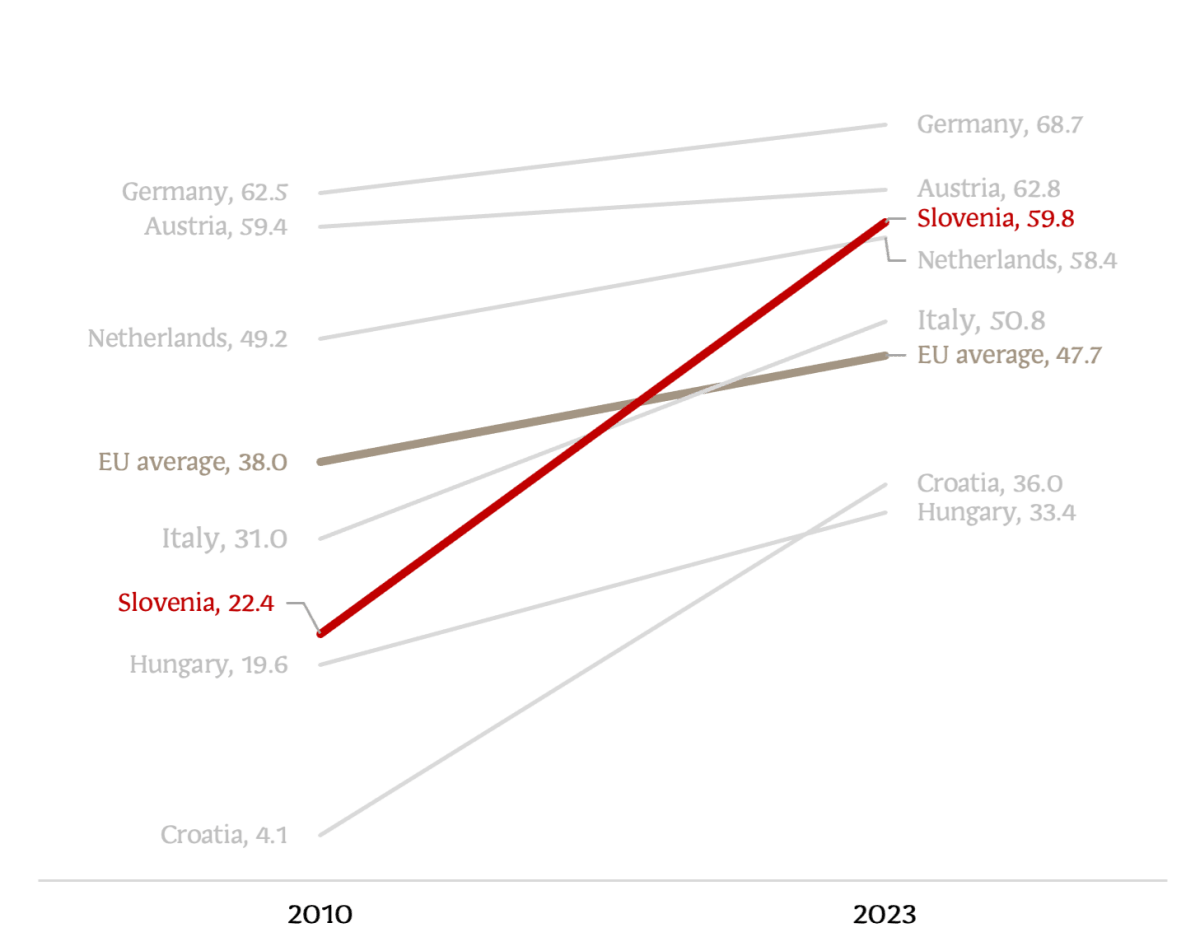
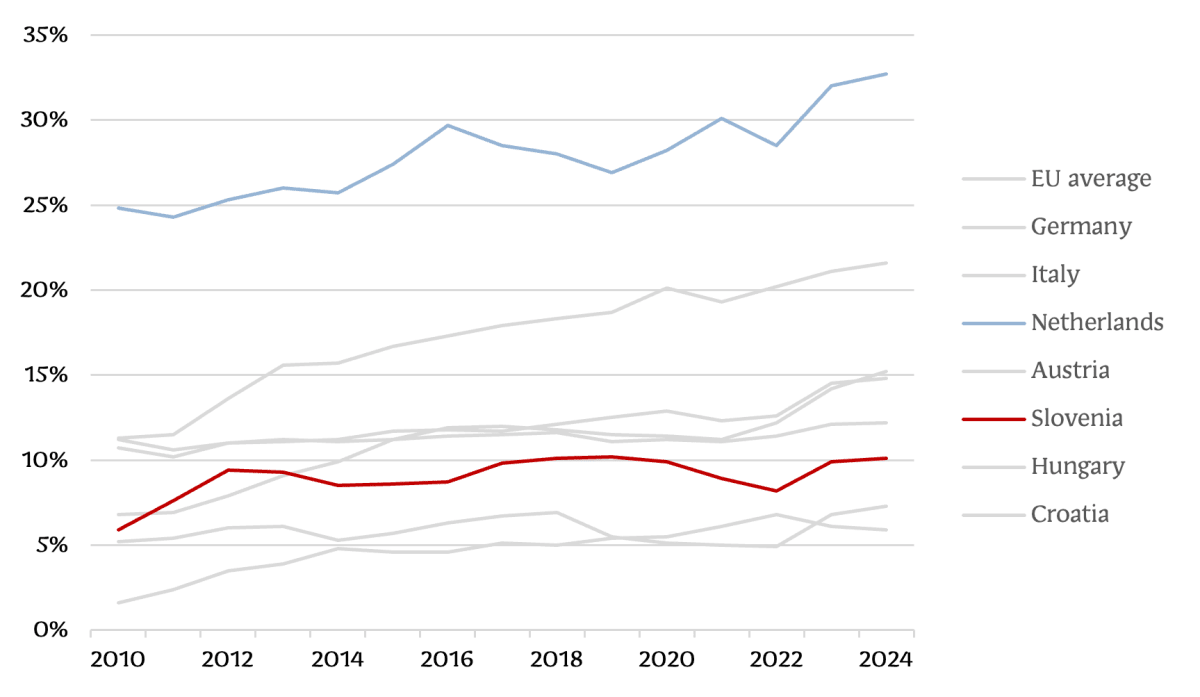
Slovenia recycles 59.8 per cent of its municipal waste, against a European Union average of 47.7 per cent, a figure that places it among the better performers in the bloc and that its environment ministry has cited for a decade as evidence of a system working. Yet only 10.1 per cent of the material entering the Slovene economy comes from recovered sources. The distance between those two numbers is not a Slovene anomaly but a European one, and it has stopped being an environmental question. Since Mario Draghi's 2024 report on competitiveness identified the structure of European supply chains among the bloc's central vulnerabilities, the failure to convert collected waste into industrial input has been reclassified in Brussels as a matter of strategic exposure.
The two indicators measure different things, and the confusion between them has flattered European waste policy for years. The recycling rate records how well households sort and how well collection is organised, and Slovenia does both well: separate collection is near-universal and participation is high. Eurostat's circular material use rate records something harder, namely how much of what industry actually consumes is secondary raw material. On that measure the Netherlands reaches 32.7 per cent and Slovenia 10.1.
The gap has a history, and for most of the period in which European recycling rates were climbing it was concealed by geography. The developed world's answer to the material it collected but could not use was export, and the containers of mixed plastics and low-grade recyclables moved along the same routes as everything else, towards states with lower labour costs and looser environmental enforcement. Between 1992 and 2016 China absorbed roughly 45 per cent of the world's plastic waste, functioning as the clearing house of a global recycling system whose European end consisted, in practice, of collection and shipment.
Beijing closed the route in 2018, and what the import restrictions exposed was not a shortage of environmental ambition in Europe but a shortage of domestic processing capacity. Europe depended too much on a single external market and had too little ability to turn collected material into anything a manufacturer would buy. A substantial share went towards landfills. The rest was redirected to South-East Asia, where the arrangement reappeared in modified form and where it remains vulnerable to the same decision taken by a different capital, which is the definition of a supply chain that has not been fixed.
The policy response has followed the reclassification rather than the environmental case. Because raw materials are the largest single input cost for European industry, material efficiency now sits inside industrial policy rather than beside it, and the instruments are being built accordingly. The Waste Framework Directive already carries the mechanism that matters most, the end-of-waste determination, which sets the point at which a substance ceases to be waste in law and becomes a secondary raw material that can be bought, priced, and moved across borders like any other input. The Circular Economy Act, announced but not yet in force, is expected to extend the approach through mandatory secondary content and binding recovery targets, which would convert a permissive framework into an obligation on manufacturers.
Legal reconstruction without the plant to match it stays on paper, and this is where the critique of the whole enterprise has concentrated. The argument from the degrowth literature is that a circular economy sits badly with continuous growth, on the grounds that capitalism depends on expanding material flows rather than closing them, and that recycling rates are therefore a way of managing the appearance of the problem. The empirical record is more awkward than that. European cement consumption has fallen over recent decades without economic growth stalling, which suggests that industrial value added is not tied to the volume of material processed so much as to how it is used and to the technological level of the processes involved. The constraint, in other words, is capacity and capability rather than logic. Dr. Tomaž Vuk, of the cement producer Alpacem Cement, puts the consequence for a small open economy in commercial terms rather than environmental ones. "As far as we as a local economy fail to learn how to do this, someone else will do it, and charge us for it," he said.
Underneath the industrial argument sits a measurement problem of a different order. In 2020 researchers at the Weizmann Institute of Science published a study indicating that the combined mass of human-made materials, from concrete and plastics to metals, now matches and most likely exceeds the dry mass of every living organism on Earth. What has changed is less the scale of the intervention than the rate at which it grows: since the middle of the twentieth century the volume of matter and energy extracted, processed, and discarded has caught up with the biogeochemical cycles by which the planet maintains the conditions for life. The geographer Simon Dalby's formulation for the process, turning rocks into air, understates one half of it. The rocks also become waste, which accumulates wherever decomposition cannot keep pace. Natural systems produce waste too, but they also produce the organisms that return the material to circulation. Industry has never built the equivalent subsystem for most of what it makes.
Which is why the category itself is the thing under negotiation. Alexander Wendt's argument that structural conditions acquire their consequences from the meanings actors assign to them was made about anarchy in the international system, and it transfers without much strain to materials. Mary Douglas made the anthropological version of the case decades earlier: impurity is not a property of a substance but of where the substance falls within a society's classification systems, dirt being matter out of place. The boundary between waste and resource is set by valuation, by law, and by technical capacity, and the end-of-waste mechanism in the Waste Framework Directive is that insight written into administrative procedure. A material becomes a resource when a legal instrument and a working furnace agree that it is one.
Slovenia has the first and lacks the second, and it is not alone in that. The question the Circular Economy Act will put to every member state is whether the missing element can be legislated into existence, or whether binding secondary-content targets applied to economies without the plant to meet them will simply generate a new set of flows towards whichever jurisdiction is willing to take the material and charge for the privilege.