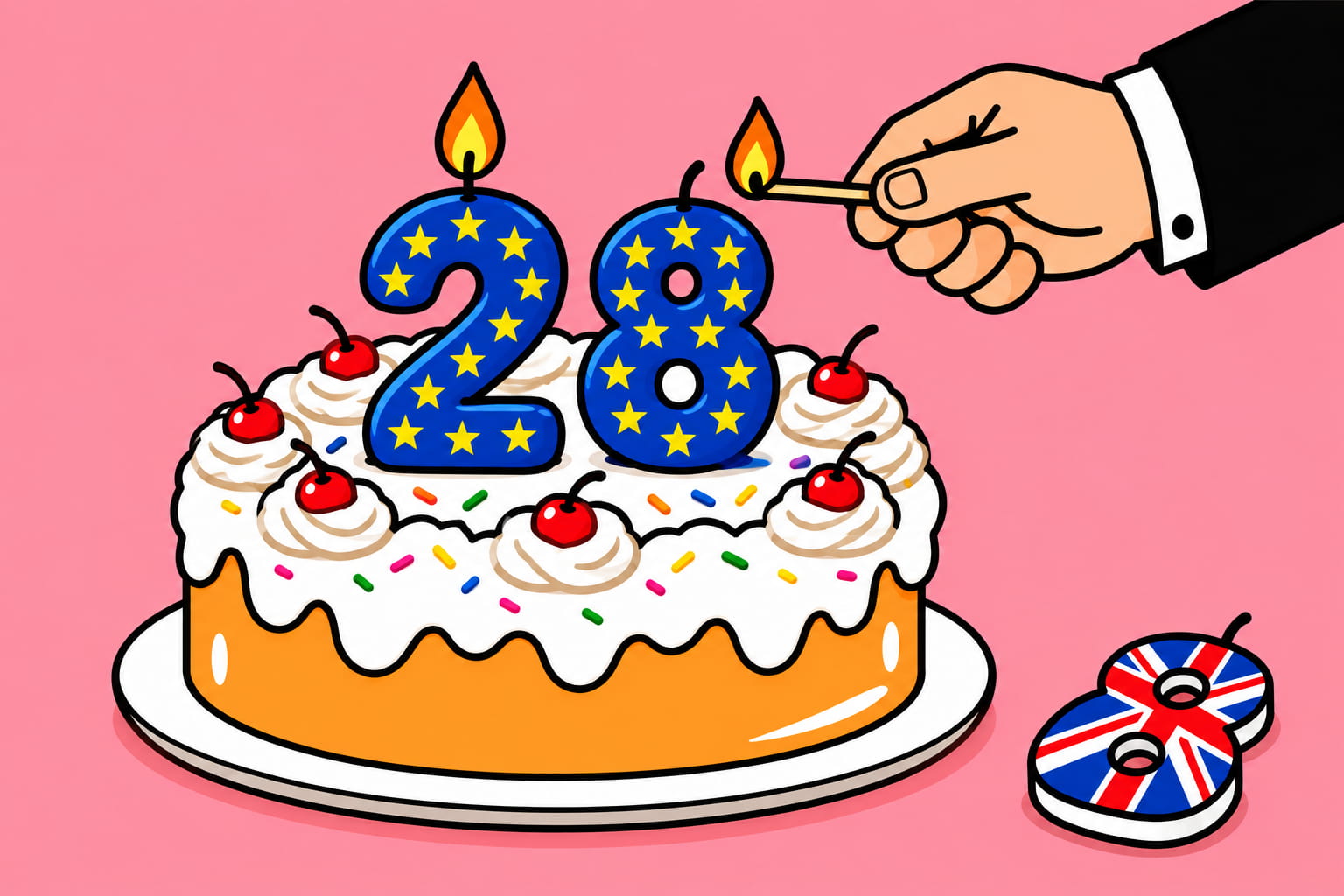
European Commission President Ursula von der Leyen capped off her tour of the Western Balkans yesterday, having taken in four of the region's six capitals. Sarajevo and Belgrade were left off the itinerary, most likely because Bosnia and Serbia vote on 4 and 25 October respectively and Brussels has no wish to invite accusations of election interference. In Podgorica she stood beside Milojko Spajić, Montenegro's prime minister, and echoed his government's slogan, 28 by 28: the 28th member of the Union by 2028. Rather than play the doom-monger, I believe the EU has set its mind to it, and that we may be spared a repeat of North Macedonia, which changed its own name in 2019 to lift a Greek veto, only to run into a Bulgarian one, and remains stuck until it writes its Bulgarian minority into its constitution.

What will matter most is what comes after 28. Does the count stop there, or do we go on counting, at least until we reach the goal set by Charles Michel, then president of the European Council? He tossed it out at Bled in 2023, rather self-aggrandisingly, to flaunt his cachet at the time, in what may nonetheless have been the best thing to happen to EU enlargement since. He made a promise, and couched it carefully, saying only that "we must be ready - on both sides - to enlarge by 2030", but nobody who read the headlines took it to mean anything other than new members by 2030. Admittedly, most of us doubted the EU would manage all six Western Balkan hopefuls, and the eurocrats in the Berlaymont, frugal as always, have since decided to push for two. The war in Ukraine had made enlargement strategic, and Michel gave it a deadline. If nobody is in by 2030, the policy will have failed in public.
"Most of us doubted the EU would manage all six Western Balkan hopefuls, and the eurocrats in the Berlaymont, frugal as always, have since decided to push for two."
Andraž Tavčar, executive editor of The Adriatic
Montenegro is furthest along, so Montenegro it is, and it will be ready, at least on paper, much like every candidate before it. Leaving aside the six founders, who set out to build a common market and not a political union, no country was ever ready until a determined few pushed it along. Greece joined in 1981 over the Commission's advice that it needed a waiting period, because the member states, with President Valéry Giscard d'Estaing of France foremost among them, wanted its young democracy anchored in Europe. Romania and Bulgaria joined in 2007 with their courts and anti-corruption work still under supervision, and Brussels went on issuing report cards on both until 2023. The plans the Commission is due to present on 7 October, under which new members would face safeguards against backsliding after they join, are practice put to theory.

The same plans have a second half as well, and that one is written for the countries that will not be 28th. The idea is that candidates would be let into EU programmes, and into parts of the single market, well before anyone offers them a seat at the table. Roaming charges are already being negotiated away, and there is a Growth Plan worth 6 billion euros to go with it. What none of this is expected to produce, however, is a common timetable. So the others get the perks and no date, and I think the perks are still worth having.
My idea of Europe is a banal one, and I see it mostly in the ease of access. It is being able to cross a border without noticing that I have done so, or to take a job in another country without first having to hire a lawyer. It is a small thing to build a politics on, I admit, but it is the part of Europe that most of us actually use. I hold, with the faith of a man who never carries an umbrella, that societies change when their people mix, because sooner or later they have to reconcile what they have seen elsewhere with what they put up with at home. And I suspect that money works in much the same way. Some of the region's more entrenched networks of patronage have never really had to compete with European capital, and I doubt they would enjoy it very much. That holds, of course, only where the newcomer has a court and a procurement rule to appeal to when things go wrong. And only fully fledged membership provides those.
"I hold, with the faith of a man who never carries an umbrella, that societies change when their people mix."
Andraž Tavčar, executive editor of The Adriatic
The obvious objection is that a frictionless Europe is also an easy one to leave for, and the region has been emptying for years. I happen to think the people who leave are part of how the change comes back. When Moldova voted in 2024 on writing EU membership into its constitution, only 45.4 per cent of those inside the country said yes. Abroad it was 76.8 per cent, and that was enough to carry it.
As for what comes after 28, that is a matter of political will, and will, as ever, follows pressure. For now the pressure is supplied by Michel's date and by the war, and a flag-raising in Podgorica in 2028 would settle the first of them. Albania, the other of the Berlaymont's two, closed its first three negotiating chapters in July, with 30 still to go. As it happens, 29 by 29 is still going spare.