Slovenia's infrastructure constraint is not capital. Its energy companies are lightly borrowed and its banks are lending. What the country produces less reliably is investment.
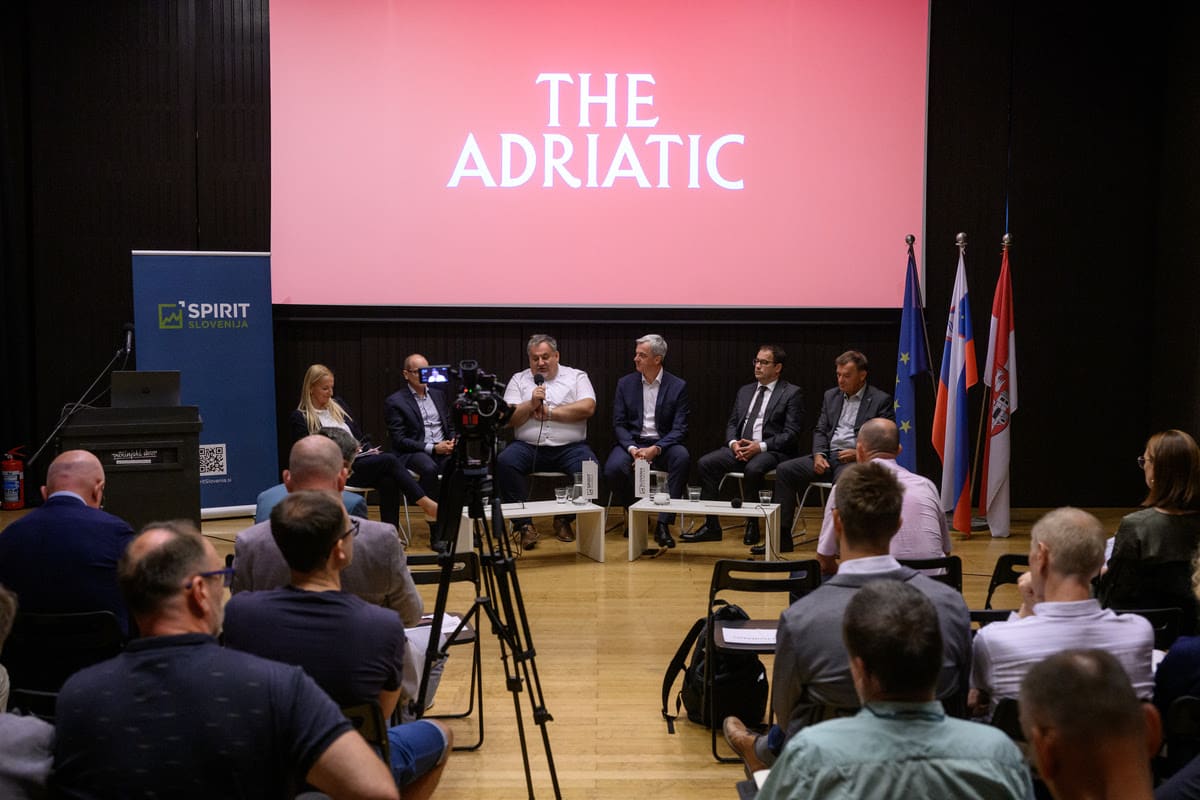
Andrej Lasič, a member of the management board at NLB, put it bluntly at Preklop 2.0, a business forum on regional development and value creation held in Maribor on 4 September. The Institute for Strategic Solutions (ISR) convened it with SPIRIT Slovenia, the national investment-promotion agency, the Ministry of Economy, Labour and Sport, and the City of Maribor. "Most of the energy projects we are currently financing are abroad, while the last major energy project in Slovenia was the Brežice hydroelectric plant, around 13 years ago," he said. The balance sheets are not the reason. Slovenian energy companies carry debt of less than one times EBITDA, against a norm of three to four times among comparable firms elsewhere.
For a country planning a new nuclear reactor, more renewable generation and an overhaul of its electricity system, that is a strange place to be. Infrastructure debates are usually arguments about affordability. In Slovenia the prior question is whether a project can become definite enough for affordability to arise at all.
The Maribor test
Maribor has its own version. The city wants a waste-to-energy plant able to process around 50,000 tonnes of non-recyclable material a year. Jože Hebar, director of Energetika Maribor, puts the cost at 80 million to 100 million euros, the largest investment in the municipality's history. It would supply more than 60 per cent of the annual heat demand of the city's district heating network.
This is not a scheme in search of a purpose, given that Eastern Slovenia, Koroška and Prekmurje already generate residual waste that has to be treated somewhere. Maribor already runs a heating system that needs heat. The economics come from joining the two. What decides whether it exists outside a presentation is a state decree and the award of a concession.

What JEK 2 has to prove
The scale changes at Krško, where Slovenia is preparing JEK 2, a second nuclear unit. The problem is the same: turning a strategic intention into a sequence of decisions that investors, suppliers and the public can treat as real.
Danijel Levičar, adviser on nuclear technologies at GEN energija, said the company is working towards a final investment decision by 2028 and first nuclear concrete in 2032. The project sits inside Slovenia's climate and energy strategy, with studies and spatial planning under way. "In the local environment, between 80 and 85 per cent of residents support the project, which is 15 per cent more than at national level," Levičar said.
On current estimates, he added, Slovenia could fund the whole project without affecting its sovereign credit rating. That does not make JEK 2 cheap. It does mean the argument about it cannot be reduced to whether a small country can raise the capital.

Lasič's figures point the same way. An energy system carrying debt below one times EBITDA has a great deal of unused borrowing capacity by international standards. Conservative finances are usually a virtue. Carried far enough, they are evidence that too little is being built.
There are respectable reasons for caution. Power stations and transport links last for decades, impose costs on neighbours and can leave customers or taxpayers carrying the consequences of a bad forecast. A slow approval system may be doing exactly what it was designed to do. The difficulty begins when caution stops distinguishing between good projects and bad ones.
Land an investor can price
Tamara Zajec Balažič, director of SPIRIT Slovenia, the investment-promotion agency, put the problem in terms of land. "We don't have enough land where an investor would know in advance what can be built, what procedures await and how long they will take," she said. For a company choosing where to site a greenfield factory, that is not administrative detail. It is part of what is being bought.

Slovenia can offer skilled workers, an industrial tradition and access to the European market. Those advantages compete against countries able to hand an investor serviced land and a timetable that behaves like a timetable. A board weighing Slovenia against its neighbours does not need Slovenia to refuse the project. A two-year wait of uncertain length does the same work.
Capital can be raised and the demand for infrastructure is plain. What stays small is the number of projects developed far enough to absorb large sums. Energy shows it most sharply: Slovenia wants secure supply, decarbonisation and competitive prices, which together imply substantial new generation and a modernised grid. Every year in which the pipeline moves more slowly than the system ages makes the eventual adjustment larger.
Delay does not hold the position steady either. A waste plant not built leaves the waste to be treated and the heat to be produced. A power station postponed does not reduce future demand. Infrastructure decisions can be deferred. The systems they serve do not stand still.
So the number to watch in Lasič's account is not the 13 years since Slovenia last completed a large energy project. It is the borrowing capacity sitting unused behind it. A heavily indebted utility sector and an exhausted sovereign would leave the country with few choices and a ready excuse. Slovenia has neither. "We need vision and courage. Without that, it won't work," Lasič said.