
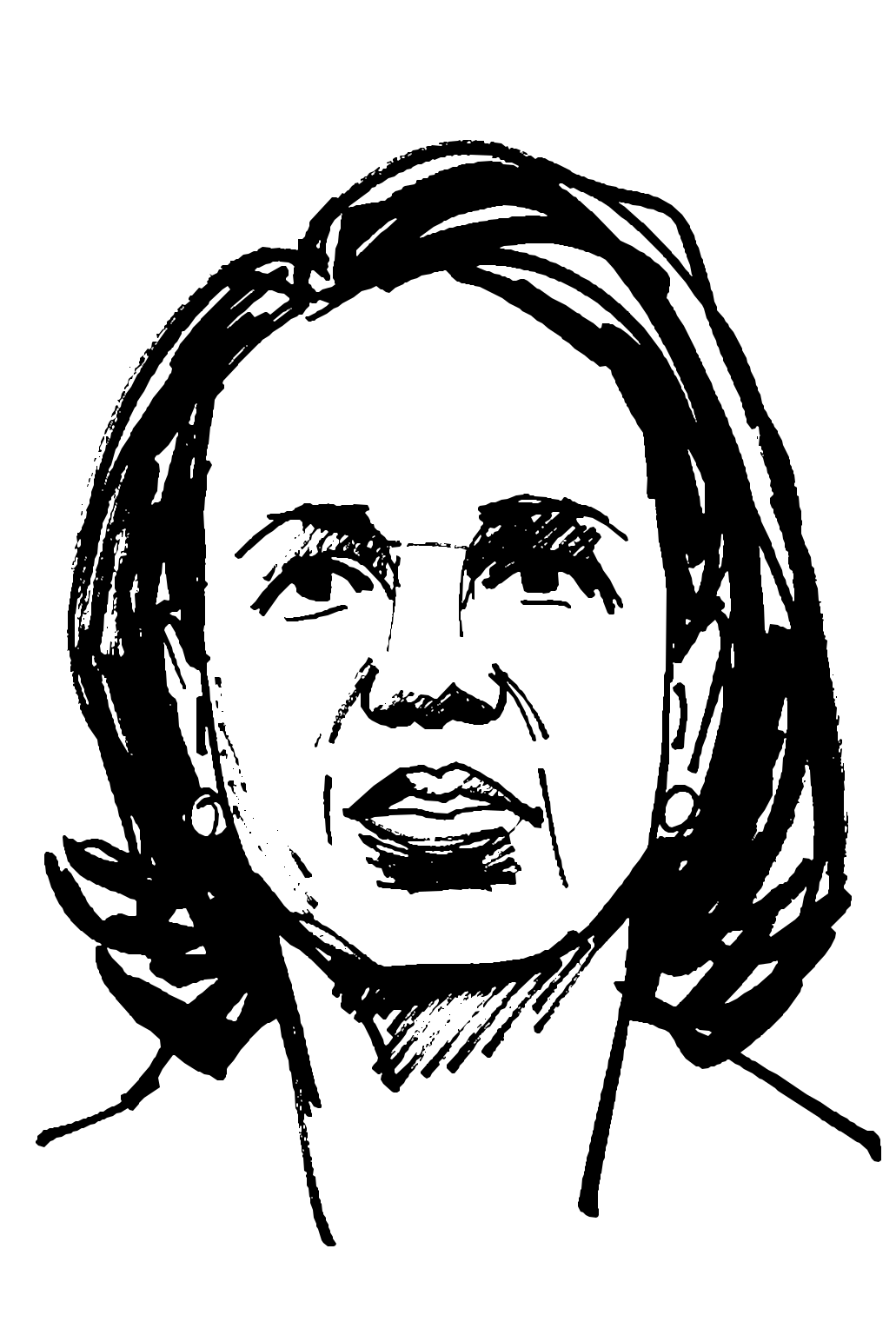
On 6 March 2026, with American and Israeli aircraft still flying sorties over Iran, Condoleezza Rice walked into the White House. The visit was, officially, about college sports. She had been invited to a roundtable in the East Room to discuss name-and-likeness compensation and conference realignment -two subjects she knows well, having served on the College Football Playoff selection committee and holding a stake in the Denver Broncos. President Trump thanked her personally for coming. The television cameras caught her in the corridor.
It was the corridor that mattered. A day earlier, Rice had told Fox News that Iran was “essentially defenseless” and urged the administration to press its advantage before that window closed. The college sports meeting gave the visit a clean official purpose. It did not change what everyone watching understood: the woman who helped take the United States to war in Iraq in 2003 had come to Washington to give her blessing to a war in Iran.
Her name, as her mother intended it, means “with sweetness.”
Rice was born in Birmingham, Alabama, on 14 November 1954, into the segregated American South. As a girl, she knew one of the four children killed when white supremacists bombed the 16th Street Baptist Church in 1963 -a fact she has returned to throughout her public life as both biography and argument, evidence that America contains its worst history and survives it. Her father, John Wesley Rice Jr., was a Presbyterian minister and college administrator; her mother, Angelena, taught music and science. The combination produced a child who practised Brahms before breakfast and read voraciously.
She entered the University of Denver at 15, intending a career as a concert pianist. A course on international politics derailed her. She shifted, completing a doctorate in political science by the age of 26, specialising in the Soviet military and Eastern European security structures -fields that, in 1981 when she joined the Stanford faculty, sat at the strategic heart of the Cold War. George Shultz, Ronald Reagan’s secretary of state and a Hoover Institution fellow, noticed her and folded her into his circle. It was Shultz who recommended her for a seat on Chevron’s board of directors in 1992; the oil company, grateful for her knowledge of Kazakhstan, named a 129,000-tonne supertanker after her. The tanker was later renamed, quietly, amid the controversies of her later career.
She served on the National Security Council under the first President Bush, managing the Soviet collapse and the diplomacy around German reunification. By 1999 she had left Stanford to run foreign policy for the second Bush’s presidential campaign, and when he won she became National Security Advisor -the first woman to hold the position.
The story of Rice and Iraq has been told often enough that its broad facts require no embellishment. She was among the most forceful advocates for the 2003 invasion, arguing that Saddam Hussein’s weapons programmes posed an unacceptable risk. In a January 2003 op-ed in The New York Times she accused Iraq of lying to weapons inspectors. On CNN that September she offered the image -prepared by communications staff, she later said, but she delivered it -of a mushroom cloud as the consequence of inaction. It became the most memorable phrase of the pre-war argument.
No weapons were found. Iraq descended into a civil war that killed hundreds of thousands and stretched American forces for nearly a decade. Rice later acknowledged that the intelligence had been wrong, though she maintained that removing Saddam Hussein had been the right call regardless. She also noted, at a Stanford business school event in 2010, that Iranian-made roadside bombs had accounted for as much as 75 to 80 per cent of American casualties in Iraq -a figure that, in the current climate, has returned to circulation.
She became Secretary of State in 2005 and served until 2009, managing the later years of both the Iraq and Afghanistan wars while attempting to broker a settlement between Israelis and Palestinians. Critics said she was too close to the White House to push back when it mattered; supporters said she stabilised a policy architecture that had badly frayed. The argument was never resolved. She returned to Stanford in March 2009 and has been there since, running the Hoover Institution from 2020.
The Fox News appearance on 5 March was her first prominent re-entry into the debate over a major military conflict in years. Her argument was direct: Iran had been at war with the United States, through proxies and by other means, for 47 years; the strikes of Operation Epic Fury represented not an escalation but a long-overdue response; and the administration should use the current moment of Iranian vulnerability to permanently degrade its military capacity.
She described Iran as “essentially defenseless” in the immediate aftermath of the strikes, which killed Supreme Leader Ali Khamenei and destroyed significant portions of the country’s air-defence and naval infrastructure. The window would close, she said. The right response was to act through it. Her formulation -that the goal should be to “neuter Iran as a military power in the region” -was precise in a way that suggested preparation. She is not a politician who speaks casually.
She did offer one qualification: the administration should guard against “mission creep,” the gradual expansion of stated objectives that had turned a three-week invasion of Iraq into a decade-long occupation. She described the risk as real. Whether her caution registered as constraint or simply as the acknowledgement required to claim credibility was a question her interviewers did not press.
What strikes observers of American foreign policy is not the argument Rice is making -it is structurally similar to what she made in 2002, adapted for a different country -but the ease with which an administration otherwise hostile to the foreign-policy establishment has received it. Trump’s team has shown little appetite for the advice of Bush-era officials, many of whom it regards as architects of exactly the kind of expensive, open-ended interventionism it was elected to repudiate. Pete Hegseth, the defence secretary, frames the Iran campaign in the populist register: 47 years of Iranian aggression, American blood in Beirut and Kabul, scores finally being settled. It is a different idiom from Rice’s, but it arrives at the same operational conclusion.
She offered no criticism of the decision to strike. She praised the operation. The administration thanked her for attending the college sports roundtable. The cameras caught her in the corridor on the way in.
The supertanker that once bore her name was, in the end, just a supertanker. It carried oil across the world’s shipping lanes for years before the name became inconvenient. The oil kept moving either way.