|
22 August 2026
|
||||
|
||||
|
Published by the Institute for Strategic Solutions (ISR)
|
||||
|
Read this online here. Visit The Adriatic at theadriatic.si
|
||||
|
Powered by Alpacem
|
||||
|
|
||||
The agenda aheadTine Kračun As summer draws to a close, we enter the final stretch of the year. The months ahead will require us to balance the execution of this year's goals with planning for the next. Progress is rarely built alone: it comes through partnerships and cooperation across borders. For the Adriatic region, Slovenia and the ISR, this year has shown the value of early engagement. Our initiatives in Albania to build lasting trade bridges are producing results. Albania takes centre stage as the partner country at this year's MOS fair in Celje, where the ISR, alongside Spirit Slovenia and NLB Group, will host a business forum on 17 September, designed to open investment opportunities between both markets. Before Celje, our focus turns to Maribor. On 4 September, we look forward to welcoming Jernej Vrtovec, Minister of Infrastructure and Energy, alongside key industry leaders, for a conference on energy and logistics. Together, we will explore pathways to strengthen Slovenia's energy independence and reinstate Maribor as a logistical hub for Central Europe. The autumn agenda will carry this momentum with dialogues on healthcare transformation and the future of work, among other themes. Production is also underway for the next annual edition of The Adriatic, featuring an economic analysis of Bosnia and Herzegovina, with our editorial team preparing for engagements in Sarajevo. Enjoy the remaining days of summer. |
||||
|
||||
|
||||
|
|
||||
|
Tete-a-Tete Several identities at onceFaris Kočan is an assistant professor of international relations at the University of Ljubljana's Faculty of Social Sciences. His research focuses on the Europeanisation of the Western Balkans, the role of European integration in addressing the post-war past of the former Yugoslavia, and the internal political dynamics of the region's accession process.
|
||||
|
|
||||
|
||||
|
|
||||
|
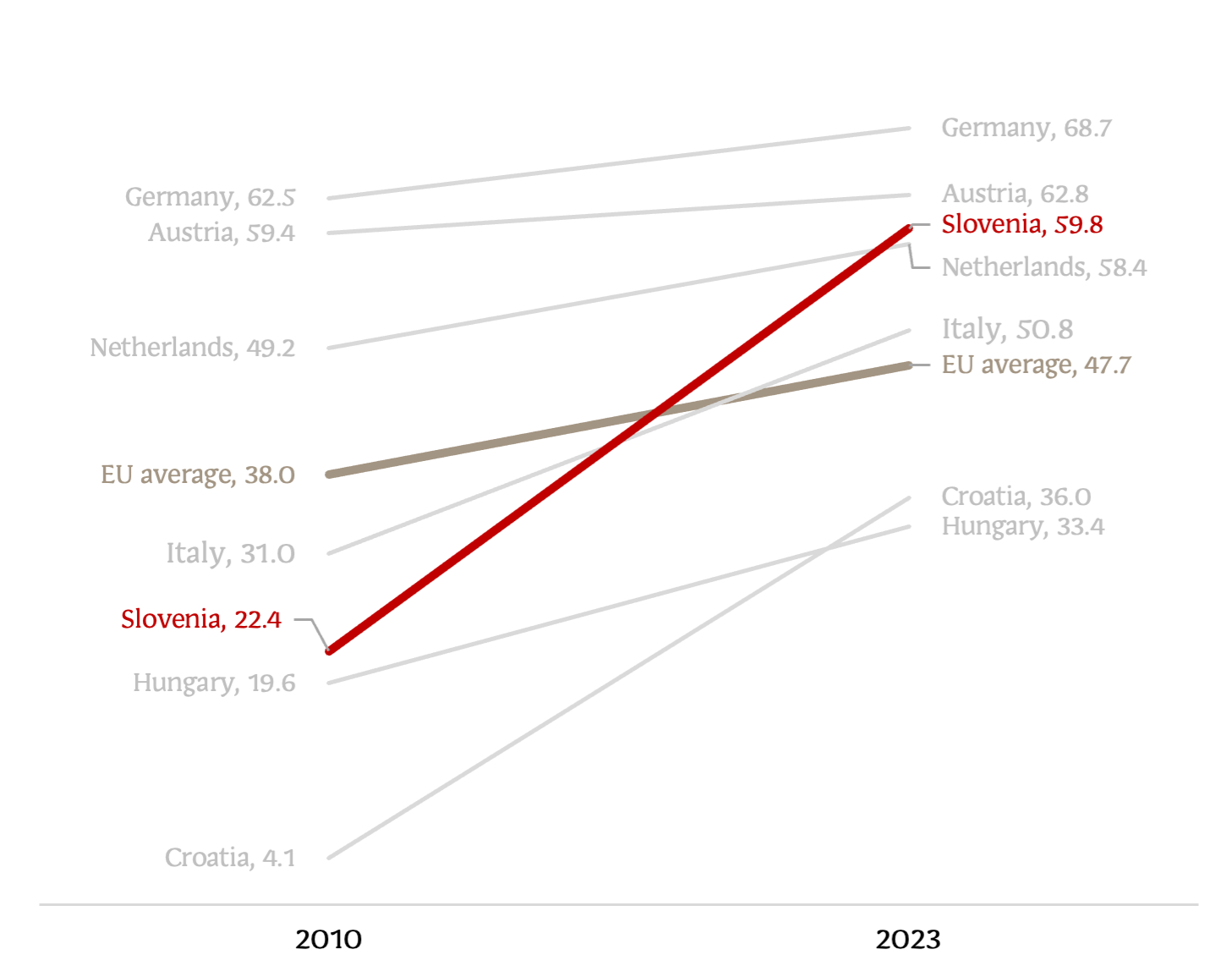
Sorted, not used The price of comfortAndraž Tavčar Slovenia recycles 59.8 per cent of its municipal waste, against a European Union average of 47.7 per cent, a figure that places it among the better performers in the bloc and that its environment ministry has cited for a decade as evidence of a system working. Yet only 10.1 per cent of the material entering the Slovene economy comes from recovered sources. The distance between those two numbers is not a Slovene anomaly but a European one, and it has stopped being an environmental question.
The two indicators measure different things, and the confusion between them has flattered European waste policy for years. The recycling rate records how well households sort and how well collection is organised. Eurostat's circular material use rate records something harder: how much of what industry actually consumes is secondary raw material. On that measure the Netherlands reaches 32.7 per cent and Slovenia 10.1. Since Mario Draghi's 2024 report, the failure to convert collected waste into industrial input has been reclassified in Brussels as a matter of strategic exposure. Read more here. |
||||
|
||||
|
|
||||
|
In Brief A Ukrainian national was detained in Pula on 19 August under a European arrest warrant. German prosecutors, who identify him only as Vladimir Z. under privacy rules, allege that he helped plant explosives that destroyed three of the four Nord Stream pipelines in September 2022, seven months into Russia's full-scale invasion of Ukraine. Germany is seeking extradition, though a Polish court refused to surrender a man of the same name and initial back in October, calling the attack a legitimate act of war. Serhii K., the former Ukrainian officer accused of co-ordinating the operation, was arrested a year earlier on Italy's Adriatic coast. Amir Zukić was dismissed after 12 and a half years running N1 Bosnia, the latest in a series of management changes across the regional broadcaster following its sale to Portuguese fund Alpac Capital. Executives have also been replaced at N1 in Serbia, Croatia and Slovenia, raising concerns among European and regional journalists' groups over editorial independence. Those concerns are particularly salient in Serbia, where N1 has long had a contentious relationship with the governing Serbian Progressive Party and has previously been the subject of efforts to reshape its management. Alpac also has a record of aggressive cost-cutting. After buying Euronews it shed close to 200 staff before returning the broadcaster to profit. Serbia's president, Aleksandar Vučić, appeared on television 49 times in the first 11 days of August, by the count of CRTA, an election-monitoring group. Between appearances he has toured the country district by district, visiting road works, factories and farmhouses on itineraries issued a day ahead by his press service. He has yet to call the parliamentary election, saying on 16 August that it would come within 15 to 25 days and be followed by a campaign of 45 to 60 days, putting the vote in late autumn. He is the governing party's candidate for prime minister. |
||||
|
|
||||
|
We're back after the August break. Catch us at the Bled Strategic Forum from 31 August to 1 September if you're around. Gripes, requests or inquiries are always welcome at [email protected].
|
||||
|
|
||||
|